Teaching the concept of poetry to middle and high school students begins with defining what poetry is.
For students this age, poetry can be one of the most exciting and imaginative subjects for students. It’s a chance for them to express themselves, explore their emotions, and develop a deeper understanding of language and meaning. However, in many classrooms, there is a tendency for teachers to box students into a specific way of thinking about poetry. Rather than providing opportunities for students to explore the text and make their own interpretations, teachers often give students the “answers” they think they should remember, leaving little room for creative thought or individual insight.
This is particularly evident when teaching poetry. Poems are often packed with layers of meaning, multiple interpretations, and emotions that are not always clear-cut. Instead of encouraging students to dive deep into the poetry and form their own connections, many lessons focus on making sure students remember specific “facts” about the poem: who wrote it, when it was written, and the “correct” interpretation of its meaning. While these are useful academic points, they don’t necessarily foster a student’s ability to think critically or creatively about the poem.
At the heart of this issue is the way we, as educators, define success in the classroom. In our desire to prepare students for exams or standardized tests, we sometimes forget that real learning happens when students are given the space to ask questions, challenge ideas, and develop their own understanding. By focusing too much on memorization, we risk stifling students’ natural curiosity and creativity, which are essential skills for both academic success and personal growth.
The Gallery Walk: Defining Poetry on Their Own Terms.
One of the first steps to unlocking creative engagement with poetry begins with students defining what poetry actually is. Too often, students are taught that poetry is simply a set of “rules” they must follow. But poetry can be so much more than that. To allow students to see poetry as a dynamic, ever-evolving form, we can start with a gallery walk—an exercise designed to help students experience poetry in an open and non-judgmental way.
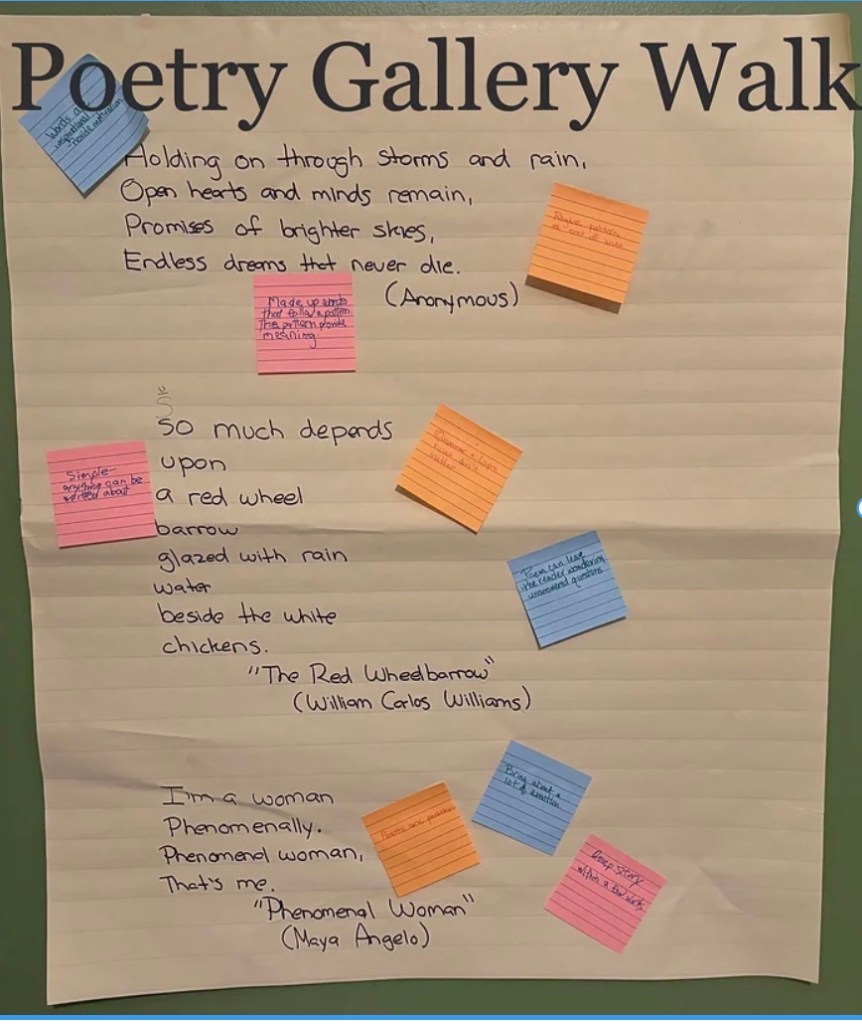
A gallery walk offers an opportunity for students to examine a variety of poems in pairs or small groups. The wider the selection, the better. Poems with different themes, structures, and forms encourage students to recognize that poetry isn’t just about one style or perspective—it’s about experimentation and personal connection.
To engage with the poems, students are given colored post-it notes and asked to make a simple observation about each poem they visit. There are no guidelines other than the simple question: What do you notice? By removing the pressure to analyze every detail or find the “correct” interpretation, students are free to explore what stands out to them in each poem, whether it’s the structure, the language, or the overall tone.
As the students move around the room, observing and commenting, I take on the role of a facilitator, circulating the room and offering prompting questions when necessary. Many students initially feel reluctant to step outside their comfort zones. They might hesitate, unsure of what they’re “supposed” to notice. However, once they begin to feel comfortable in the space, their observations become more insightful and complex. They begin to comment on the structure, on what is included and what is not, on the patterns they notice—and even on the “rules” of poetry that exist and those that are intentionally broken.
Through this exercise, students see that poetry is not a rigid or confining form—it is a living, breathing thing that can be adapted and molded to fit a variety of personal and artistic expressions. By allowing students to define poetry for themselves, we are empowering them to see it as an open space for creativity and meaning-making.
*** Setting up a pre-determined rotation , with each group spending a set amount of time at each rotation keeps things moving in a smooth fashion.
The Next Step: Reviewing Observations and Expanding Ideas
After the gallery walk, it’s time to come together as a class and review the observations the students made. By discussing what they noticed across the different poems, we allow them to clarify their ideas or expand on insights they might not have fully considered yet. This class discussion encourages a deeper understanding and provides a space for students to refine their thinking. It also promotes the idea that learning is a process, and ideas can evolve as more perspectives are shared.
The Final Step: Crafting a Working Definition of Poetry
MIND MAP & WORKING DEFINITION WORKSHEET
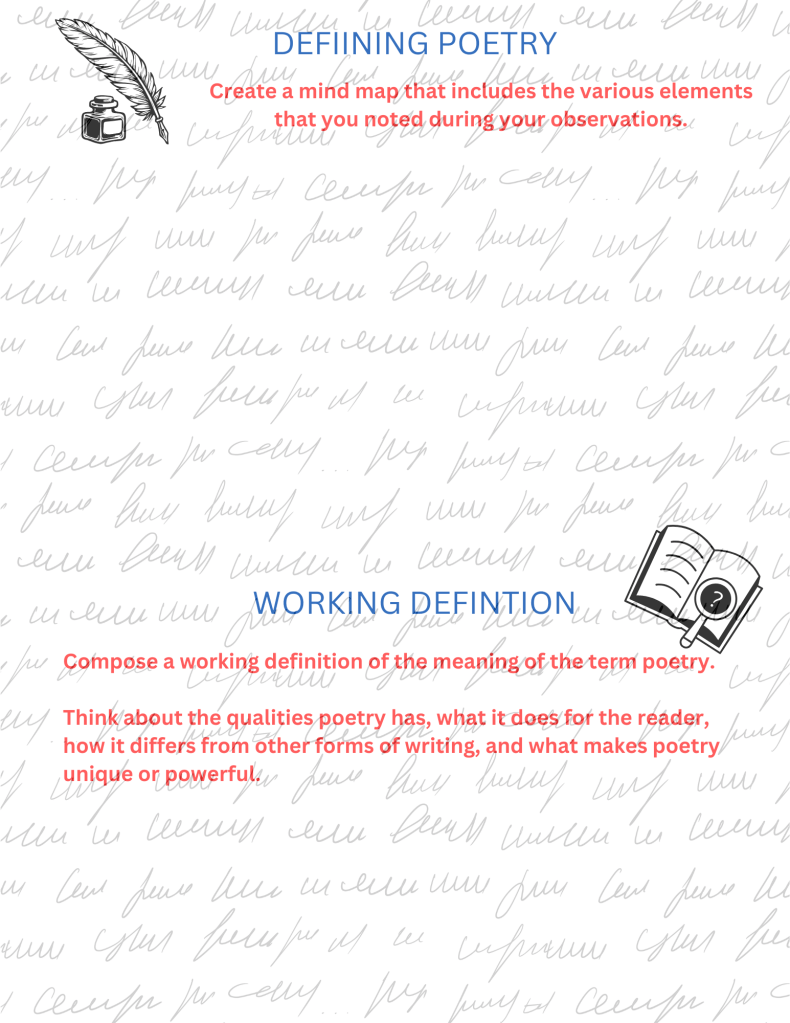
The final step is for each student to create their own working definition of poetry. This definition will be based on the insights they gathered through the gallery walk, their observations, and the class discussion. It’s important that this definition is working, meaning it is not fixed or final. Throughout the unit, as students continue to read and write poetry, their understanding of poetry may shift or deepen. And that’s okay! The goal is not to limit them to one definition but to empower them to see that poetry is a dynamic, evolving form that can speak to them in different ways over time.

Each student gets their colored post-it notes back at this stage. These notes, filled with their observations, will serve as the foundation for the next task—creating their own mind map. The students will use their post-its to visually represent the elements they believe make up poetry. This mind map will help them organize their thoughts and begin to make connections between different observations about form, language, structure, and meaning. This creation is then used to create a working definition, allowing students to claim ownership of their learning. It shows them that their interpretation of poetry is valuable and that their ideas are constantly growing and changing. It’s a starting point for the creative journey ahead.
Validation of Student Creation of Meaning of What Poetry Means
As a fun aside, sharing some definitions that poets and authors themselves have created adds validity to the idea that the concept of poetry can not be nailed down to one accepted dictionary definition. A great source for these can be found on Owlcation
Some of my favorite are:
“Poetry = Anger x Imagination” —Sherman Alexie
“Poetry can tell us what human beings are. It can tell us why we stumble and fall and how, miraculously, we can stand up.” —Maya Angelou
“Poetry is the spontaneous overflow of powerful feelings; it takes its origin from emotion recollected in tranquility.” —William Wordsworth
“The poet’s job is to put into words those feelings we all have that are so deep, so important and yet so difficult to name, to tell the truth in such a beautiful way, that people cannot live without it.” —Jane Kenyon
Defining poetry…it’s a simple start yet one of the utmost importance if we want students to be engaged in the learning process of what poetry ecompasses.
My Favorite Items that are Essential in Executing the Poetry Gallery Walk.
Click each description to Purchase.

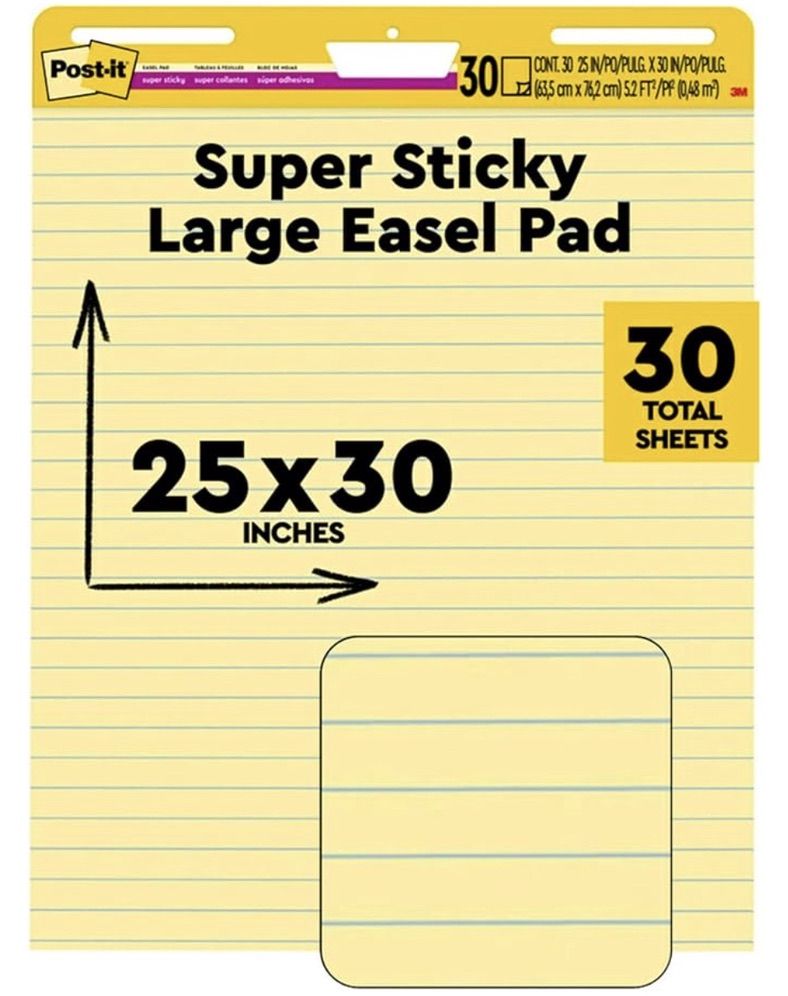
Lined Sticky Notes work Great for Differentiating Among Groups

Black Sharpies to Make Poems Stand Out
 Infinite Horizons Teaching
Leave a comment